
Attending CAIMI26 for the first time was an exciting opportunity to engage with a community focused on a question that is increasingly central to my own research: how do we move artificial intelligence from promising technical methods toward tools that are reliable, transparent, and useful in clinical practice?
As a researcher working at the intersection of data science, large language models, and medical imaging at the University of California, San Francisco, I arrived in Philadelphia looking forward not only to learning about advances in imaging AI, but also to understanding how others are addressing the practical challenges that emerge when these methods encounter real clinical data and workflows. CAIMI26 provided an unusually concentrated environment for those conversations.
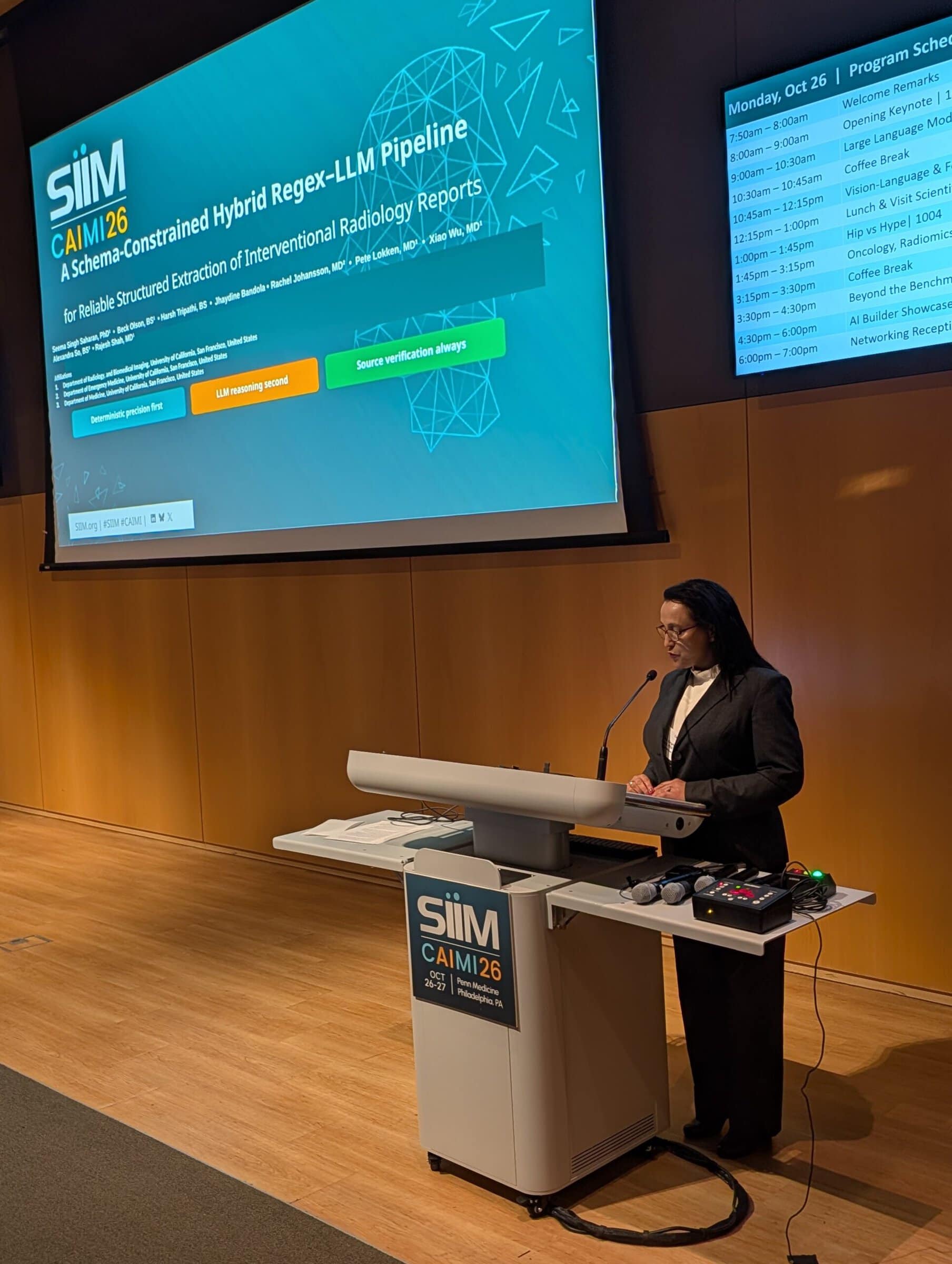
One of the highlights for me was the opportunity to present our work on a schema-constrained hybrid regex–large language model pipeline for structured extraction of interventional radiology reports. Presenting during the Large Language Models & Report Generation session placed our work alongside research exploring report generation, clinical monitoring, personalization, and evaluation of large language models. Seeing these different approaches together reinforced for me that the important question is no longer simply whether an LLM can perform a task. We also need to ask how reliably it performs, how its outputs can be evaluated and audited, and how the system can be designed around the requirements of a real clinical use case.
I was also fortunate to participate in the AI Builder Showcase with CXR Insight Lab, our auditable multimodal AI workbench for transparent chest X-ray interpretation. The Builder Showcase was particularly meaningful because it emphasized the process of turning an AI concept into something people can interact with and evaluate. For me, it highlighted the value of building systems in which model outputs are not simply presented as answers, but can be examined, questioned, and understood.
That theme—moving beyond model performance alone—appeared throughout the meeting. Sessions ranged from multimodal foundation models and vision-language models to agentic AI, segmentation, clinical workflows, auditing, and analytics. The program also explicitly addressed what it takes for medical AI to work in practice and, in the closing keynote, questions of value, workforce, and what comes next. Together, these discussions made the meeting feel less like a showcase of isolated algorithms and more like a conversation about the larger ecosystem required for responsible clinical AI.
Another aspect of CAIMI26 that I appreciated was the breadth of perspectives represented. Imaging AI brings together clinicians, informaticists, data scientists, engineers, trainees, and researchers who may approach the same problem very differently. Conversations across those perspectives are particularly valuable because they reveal assumptions that can be easy to miss when working within a single discipline.
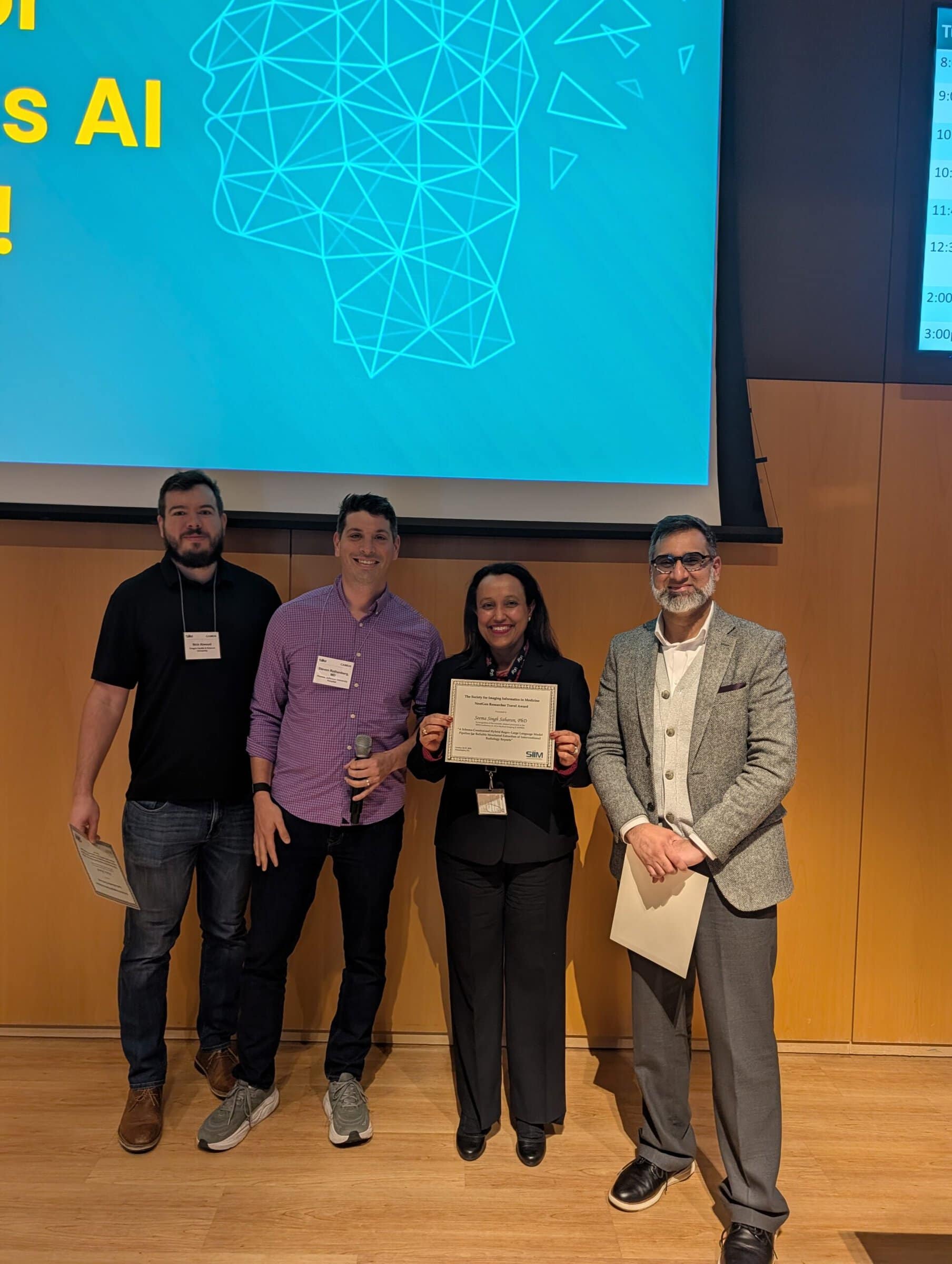
I left Philadelphia with new ideas for my own research and an even stronger appreciation for rigorous, clinically grounded evaluation of AI. As increasingly capable multimodal and language models become available, I believe some of the most consequential work will involve determining how to make these systems reliable, auditable, and genuinely useful to the people who ultimately interact with them.
I am grateful to SIIM, the CAIMI26 organizers, the session chairs, speakers, fellow presenters, and attendees for creating an environment where technical innovation and practical clinical questions could be discussed side by side. Participating in CAIMI26 as both a first-time attendee and presenter was a rewarding experience, and I look forward to continuing these conversations within the SIIM community.
Seema Singh Saharan, PhD
University of California, San Francisco

post
CAIMI26: Perspective from a First-Time Attendee and Travel Scholarship Recipient
Nick Atwood
Second SIIM event, first CAIMI CAIMI26 was my second SIIM event this year, but my first CAIMI. In June I…
post
Who Should Make Sure AI Reaches Everyone?
Yashbir Singh, PhD
Yuankai Huo, PhD
Khaled Younis, PhD
Every few months, another imaging AI tool earns regulatory clearance, promising faster reads, fewer misses, and relief for overworked radiologists.…
post
Reflections on CAIMI 2026
Alexander J. Towbin, MD
“The only way to predict the future is to invent it.” Dr. Pari Pandharipande, Chair of Radiology at the University…