
Second SIIM event, first CAIMI
CAIMI26 was my second SIIM event this year, but my first CAIMI. In June I went to SIIM26 in Pittsburgh on a hackathon travel scholarship, with an idea, and our team ended up winning the hackathon. That led to a spot on the SIIM Hackathon Committee, and it’s a big part of why I submitted an abstract to CAIMI.
Some background: I spent about 11 years at Intel, starting as an intern and ending as a cloud systems engineer, before leaving in 2024 to pursue medicine. I’m now a post-bacc pre-med student and a volunteer researcher in nuclear medicine at OHSU, working on quantitative PSMA PET/CT. The CAIMI26 Travel Scholarship is what got me to Philadelphia to present that work in person.
One room, every talk
CAIMI is small compared to the annual meeting. Everything ran in one auditorium at Penn’s Smilow Center, with posters out in the Commons. SIIM26 had multiple session rooms going at once, and SNMMI earlier this year was bigger than that.
I liked the single-room format more than I expected. You see every session, you keep running into the same people at coffee breaks, and by the afternoon of day one you’re picking up conversations where they left off. The crowd seemed to lean toward students and trainees, which made it easy to talk shop with people at the same stage I’m at.
Presenting
I presented in the Oncology, Radiomics & Segmentation session, moderated by Dr. Eliot Siegel. My abstract asked whether interpretable PSMA PET phenotypes predict how deep and how durable the response is after Lutetium-177 radioligand therapy. It’s retrospective, single-center, exploratory work, so the honest takeaway is “worth testing in a bigger cohort,” not “ready for clinic.”
Ten minutes plus four for Q&A goes fast. The questions were the part I’ll remember. Dr. Siegel asked some great ones including looking at other scans looking for how prostate cancer dedifferentiates over time. I came away with a clearer idea of what the next version of this project needs, including a larger cohort.
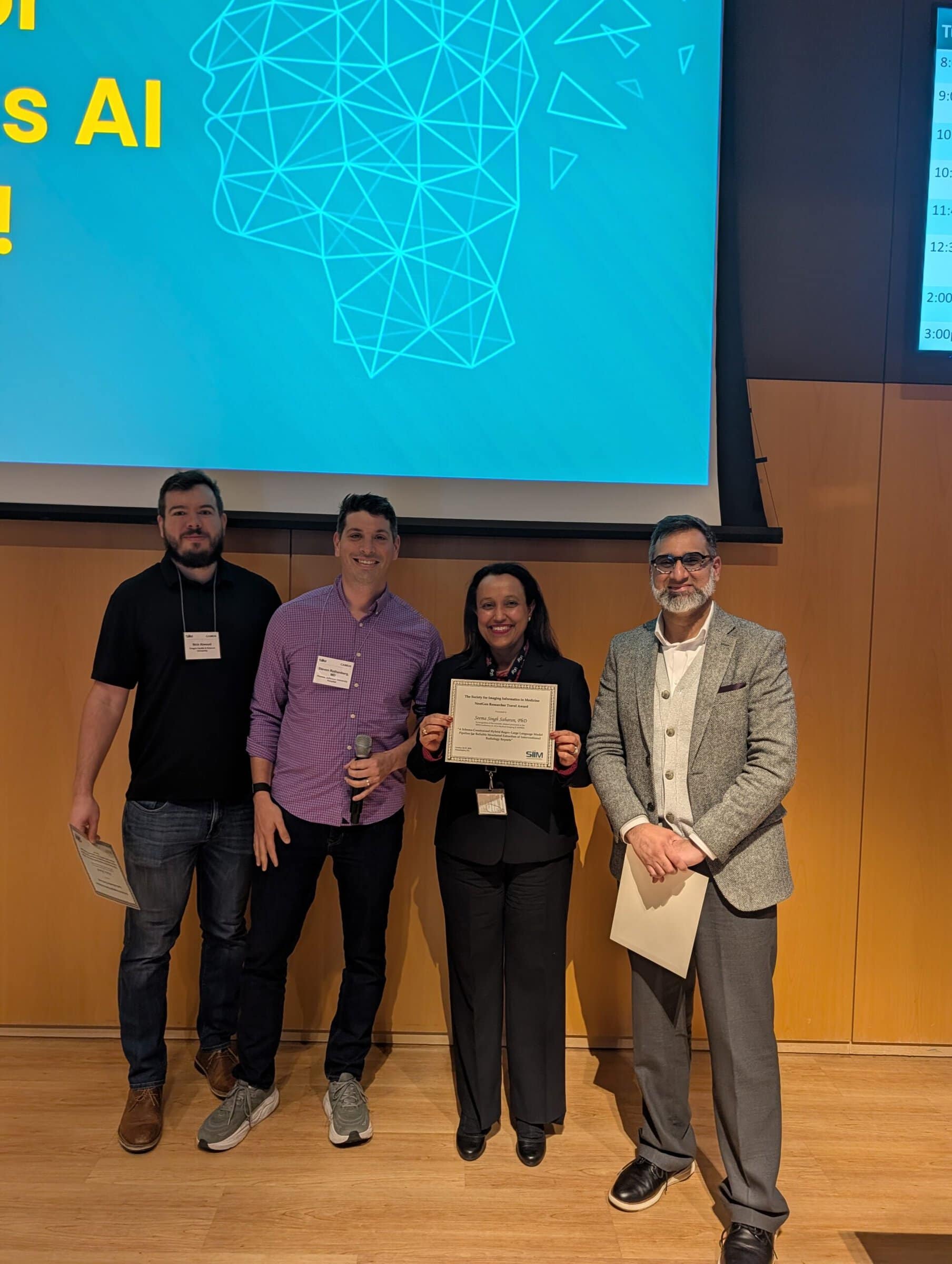
I didn’t place in the abstract awards. The winning talks were strong, and the third-place presenter’s delivery was about as polished as I’ve seen from a trainee. I took notes on that as much as on the science. I was also recognized at the closing session as a travel scholarship recipient, which meant a lot.
Talks that stuck with me
Faisal Mahmood’s opening keynote covered Apollo, a multimodal model trained on about three decades of Mass General Brigham records: 25 billion records from 7.2 million patients. The scale is hard to wrap your head around. My first thought was how well it travels. It comes from one health system, so external validation is the obvious next test, and I think searching across a patient’s whole record is the most realistic near-term use.
Pranav Rajpurkar’s keynote, “Beyond the Benchmark,” included his group’s new paper in Nature Biomedical Engineering. They took an adult chest X-ray model for breathing-tube placement and adapted it to newborns by training it one hospital at a time across 30 NICUs in 20 countries, with about 50 training images per site. Patient images never left their hospital, and the model kept improving as it moved from site to site.
That one hit close to home. My PSMA cohort is small and from one center, and the hardest question about it is whether it holds up anywhere else. Seeing a credible way to learn across sites without pooling data was encouraging.
On the poster side, I met Aditya Mantha from Johns Hopkins, whose poster used deep learning to fill in beams that aren’t acquired in cardiac color Doppler, so the scan can run faster. Way outside my lane, which is part of why I liked it.
The people
The best part of a small meeting is that you actually get time with people. I got to catch up with Les Folio, who I know from the hackathon and the committee. We always get along well, and he introduced me to another SIIM board member, Matt Hayes. Great conversations, and a nice way to end the day.
At one point Les hinted that I may end up where he is someday. Les is a extremely accomplished DO radiologist who has spent his career in imaging informatics, and my first acceptance this cycle was to a DO program, so that comment stuck with me. That’d be a wild ride, and a good one.
Real life still happens
I missed a good chunk of day two. Our oldest son cracked a tooth back home and needed an urgent dental appointment, and my wife and I spent that morning sorting it out from across the country. That’s part of being a nontraditional student with a family. I made it back for the closing session.
We did get our evenings. We went to a 76ers game, had the obligatory cheesesteaks, walked through Reading Terminal Market, tried a couple cocktail bars, and had a great dinner at Barclay Prime. Quick trip, but a good one.
What the scholarship meant
As a full-time student with kids, a cross-country trip is a real cost. The scholarship is the reason I could present this work in person, get questions from physicians who know this field far better than I do, and meet people I plan to stay in touch with.
I’m leaving with a short list: push the PSMA work toward a larger, multi-site cohort, get better at delivering a tight ten-minute talk, and keep showing up for SIIM through the Hackathon Committee.
Thank you to the SIIM team for making the logistics easy, to Dr. Siegel for moderating our session and the brilliant questions, and to Dr. Sebastian Obrzut, Dr. Nadine Mallak, Dr. Celeste Winters, and my OHSU nuclear medicine colleagues for the work behind the talk. See you at SIIM27.

post
Beyond the Abstract: My CAIMI26 Experience
Seema Singh Saharan, PhD
Attending CAIMI26 for the first time was an exciting opportunity to engage with a community focused on a question that…
post
Who Should Make Sure AI Reaches Everyone?
Yashbir Singh, PhD
Yuankai Huo, PhD
Khaled Younis, PhD
Every few months, another imaging AI tool earns regulatory clearance, promising faster reads, fewer misses, and relief for overworked radiologists.…
post
Reflections on CAIMI 2026
Alexander J. Towbin, MD
“The only way to predict the future is to invent it.” Dr. Pari Pandharipande, Chair of Radiology at the University…